The cast.
Luisa Dominguez, 34, is the ICU nurse, St. Clare’s night shift, who reads the beeping by what it is hiding. She knows the chart says 8 because the chart can say 8, and that the pain is past the language, and she is the only person in the hospital who knows it.
Harold is the patient, cancer, the one asking, whose real pain is beyond the scale the system accepts. Stephen is Harold’s son, an internist who speaks the language because the language is the distance. David is Harold’s other son, on the other side of the table. Dr. Patricia Alvarez is the palliative-care attending, twenty years of managing the dying, who delivers clarity because clarity is the compassion. Rachel Guzman is the charge nurse whose initials share the paper record. Cat Brennan works the same hospital; David Rourke sits with the dying on these floors.
The Seer is the man in the hospital chapel, fifties, nondescript clothing, hands on his knees, still the way a machine’s display is still between readings, present and ready, about to produce output.
The Seer scene.
A Tuesday night, 11 p.m., the first-floor chapel, the room where the unanswerable is permitted. The man speaks to the stained glass, not to Luisa, in the clinical cadence of a chart, naming no number and no name:
“You chart the 8. … You know the 8 is the ceiling of the language and not the ceiling of the pain. … Nobody knows you know it. I know. … You will increase the rate. Not at the rate the system has ordered. At the rate the system has not ordered. The fingers on the pump. The dial. The turn. … The breathing will slow. … The sedation is the peace. The peace is the thing the man has been asking for. The peace is the mercy.
“The death will be reviewed. … The system has a word for what the nurse did. … The nurse has enough. The system has the word the courthouse uses. Both words will be in the room. Only one will be on the indictment. … The verdict will be the jury’s recognition that the act was compassion. The compassion will be real. The compassion will also be the crime. The crime will also be real. Both will be the verdict.
“He also tells you what happens if you do not turn the dial. … Please. The word becomes the sound of the bed. … You hear it for the rest of the career. The career is long. The bed is the bed. The word is the word.”
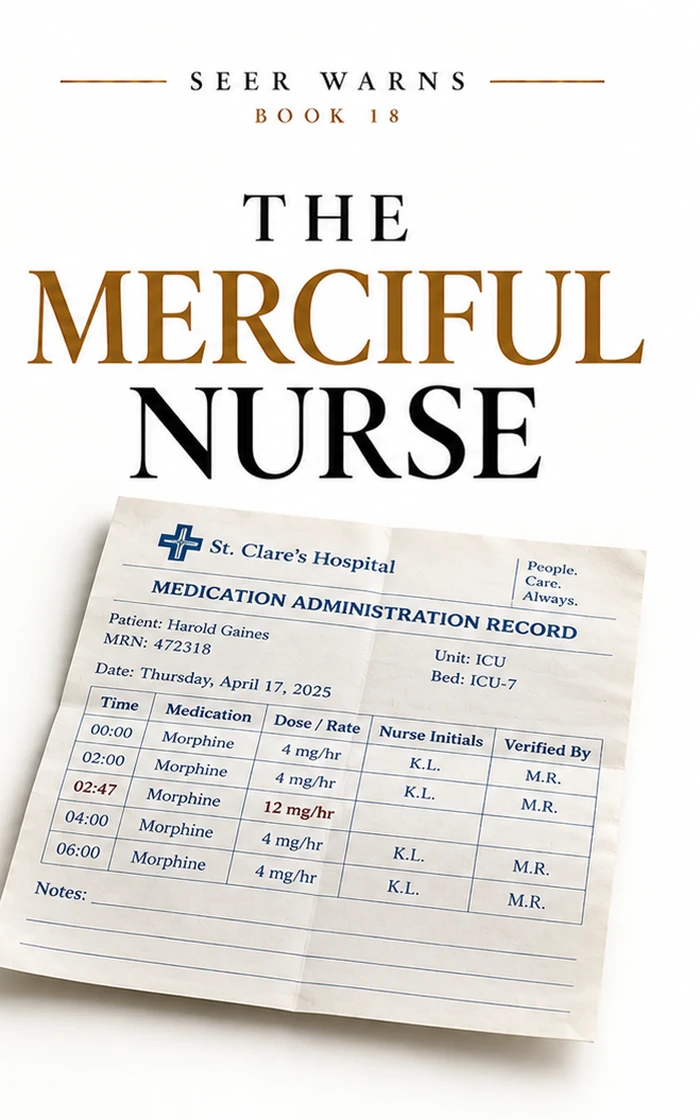
Then the one impossible specific, the 8 that is the ceiling of the language and not the ceiling of the pain, which Luisa knew from the second check of the second day and told no one and never wrote down. The man leaves a Medication Administration Record on the pew, St. Clare’s in-house blue ink, future-dated for a Thursday three weeks ahead, GAINES, HAROLD R. / BED ICU-7, every hour at 4 mg/hr, except one off-hour row at 02:47, 12 mg/hr, the initials column blank. When she looks up the pew is empty; the chapel door, which always hisses, never hissed; the security camera will later show her alone the whole time. She folds the form into her scrubs pocket.
The warned choice.
Loss A: turn the dial. Give Harold the rate the system did not order, the sedation that is the peace he keeps asking for, and let the medication record carry, in the row where nurses sign, the act the criminal code has a name for, the review, the board, the trial, the prison.
Loss B: hold the line. Chart the 8, leave the rate at 4 mg/hr, tell the system the truth it tells itself, and carry the word please as the sound of the bed for the rest of a long career, the mercy withheld and the suffering preserved.
This is the series’ cruelest symmetry: both words, enough and the courthouse’s word, are true, and both are real at once. The man does not tell Luisa what to do; he tells her that the compassion is the crime and the crime is the compassion, and that the cost lands either way, on her record or in her ears. She believes him because the 8 is the gauge, a thing that lived only inside her reading. After three weeks of holding the line, she turns the dial.
The fracture tell.
The chart, and the chapel. The gap between what the record can say (8, 4 mg/hr, “no change to current orders”) and what the nurse knows (the pain past the language) is the book’s whole moral architecture; Luisa lives in that gap, the system’s version, the camera’s version, and her version, three records of one night. The chapel, visited four times in twelve years and never before with another person in it, marks the threshold; the fifth visit, three years and a prison sentence later, marks what she becomes.
The outcome.
Pyrrhic survival. Luisa turns the dial at 02:47 exactly as the form foretold. Harold dies at peace; the review reads the row; the indictment carries the courthouse’s word; the jury recognizes the compassion and writes the smaller number; she serves less than the sentence. But the prophecy opens past the prison. She returns, works hospice, and gives the rest of a long career to palliative care, the protocol that lets the dying be comfortable inside the law, “the 8 was the ceiling of the language; the 3 is the answer; the 3 is the protocol; the carrying is the carrying.” Her name reaches a federal statute on end-of-life care. She lost her freedom and her license to the act; she gained a vocation, a witness group, and a change in the law that means the next nurse will not have to turn the dial alone in the dark.
How it touches the other books.
One of St. Clare’s hospital books; the word please here answers the word fine that Cat Brennan keeps meeting in The Tired Mother and that Neil Mercer hides behind in The Steady Hand. Dr. Patricia Alvarez is the shared palliative attending across the hospital books, and The Silent Pastor’s David Rourke sits with the dying on the same floors.