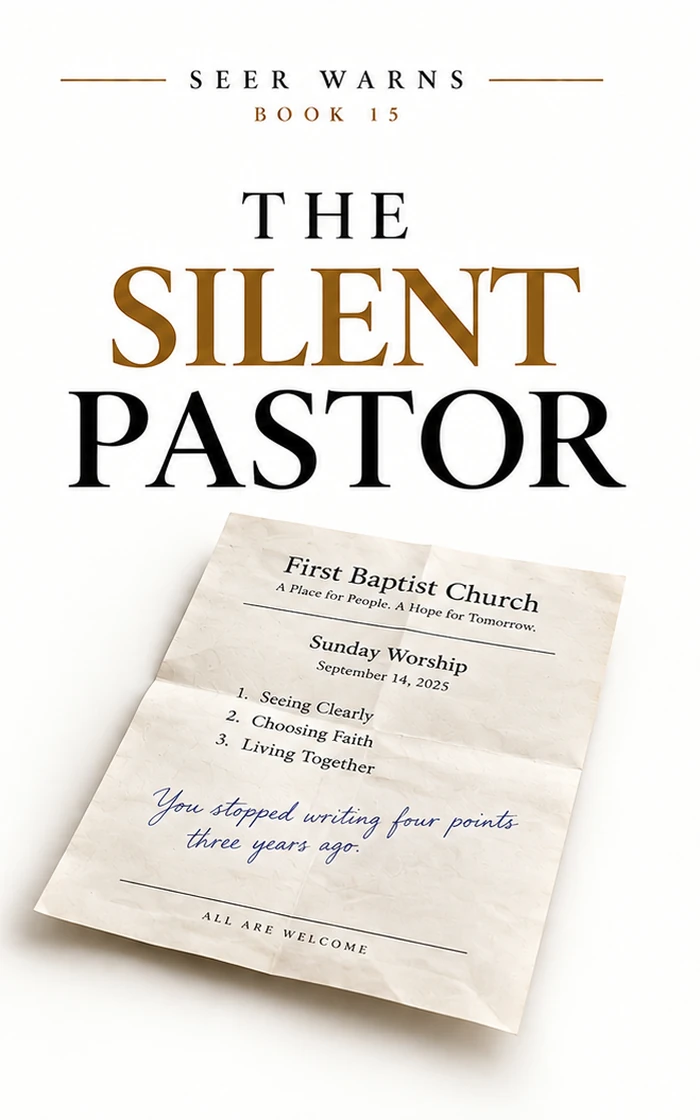
The cast.
David Rourke, 54, is the pastor, twenty-four notebooks of handwritten sermons, the forty-seventh notebook whiter than the others. He reads a room the way a minister reads it, and the gap he cannot read is the one in his own chest.
Linda Rourke is the wife who married a pastor, the one who says at the kitchen table on a Tuesday evening, I can see you’re not in the room anymore. Martha Ingram is the parishioner in Room 412, the hand David will hold, whose daughter will watch his face. Ellen is the daughter at the bedside, who can hear the difference between the saying and the meaning. Wendell is the deacon who asks the question the congregation has not asked. Hannah is the next pastor, who will wrestle the three days David no longer wrestles. Earl Henderson, on the Lamplighter bench, gives David the sentence he has carried since 1976, that the booth will hold the thing he cannot yet carry into his own kitchen.
The Seer is the woman in the clinic waiting room, fifties, plain practical county clothing, hands still in her lap, present for a reason the room’s stated purpose does not explain.
The Seer scene.
A Thursday evening, the Harmon Clinic waiting room, David between visits to the dying Martha, cold vending-machine coffee in his hand. The woman speaks to the vending machine, not to him, in the register of a pastoral assessment, naming no name and no date:
“The woman in the third pew is going to die. … You will sit at her bed and take her hand and say the words. The words will be correct. … Her daughter is the kind of woman who can hear the difference between the saying and the meaning. She will hear it. … She will say it to your wife at a potluck, … and the saying is the door.
“Your wife will ask. … She knows. She has known the way the people who live in the house with the pastor know. … She will say it at the kitchen table. … You will hear it as the marriage. The marriage will be asking.
“You will leave the pulpit. Leaving the pulpit is leaving the house … leaving the town … leaving the marriage, because the woman who married you married a pastor and the pastor is the thing leaving. … You will gain the silence. The honest silence. … The secret is the preservation. The truth is the loss. Both are yours.”
Then the one impossible specific: she leaves a church bulletin on the plastic chair, folded in quarters, printed in his own Garamond on his own $42 ream from the Granger printer, the Sunday, February 26 service, three weeks back, and on the back, below his three sermon points in careful schoolhouse cursive, one sentence in blue ballpoint: “You stopped writing four points three years ago.” The fourth point was always the calling point, the one that required feeling. David edited it out in 2021 and called it economy. The faith had not left in 2021; the feeling had. The diagnosis is in his own hand. When he looks up the chair is empty; no door has moved.
The warned choice.
Loss A: tell the truth. Let the daughter hear the gap, let Linda ask the question, say the sentence to the deacon board (it is not a season; it is the climate), and walk out of the pulpit, and the parsonage, and the town, and the marriage that was built on the pulpit, into the honest silence where the faith used to be.
Loss B: keep the secret. Go on preaching from the inventory, saying the correct words with the conviction the role requires, hold the marriage and the house and the town together on a faith that is gone, and be the man who knows the river is dry and keeps drawing from it.
David believes the woman because the fourth point is the gauge, a thing he had not told himself, let alone another soul. The truth costs everything the secret preserved; that is the exchange the woman names and the one he cannot un-hear once Martha’s daughter opens the door.
The fracture tell.
The notebooks, and the fourth point. Twenty-four notebooks of sermons measure twenty-four years of a calling; the forty-seventh, whiter than the rest, is the one started after. The book reads the loss of faith not as a crisis but as a quiet structural edit, the disappearance of the feeling-point three years before anyone, including David, noticed, the river going dry while the channel kept carrying what the delivery left behind. When the fourth point returns to the page, the reader knows what was rebuilt.
The outcome.
Complete collapse. Everything the woman named arrives, and because the town is the church and the pastor is the town, each loss triggers the next until the cascade is total. Martha dies; the daughter hears the gap; Linda asks at the kitchen table; the deacon board hears the sentence; and David leaves, the pulpit, the parsonage, the town, and the marriage, because leaving the faith means leaving all of it. There is no firm to return to, no family in the next room, no building with his name on it. The ending is the most stripped-down in the series: a man in an apartment with a card table, a $19.99 coffee maker, a pen, and a journal, writing the radical, quiet honesty of a person who chose the truth over the comfortable. He says the words at his mother’s nursing-home bedside not knowing whether she hears them or whether God does, only that the saying is the saying. The quiet is purchased with everything he had, and the quiet is enough.
How it touches the other books.
First Baptist is the series’ pulpit, and David’s register rhymes with the other professionals read in their own language across the books. Cat Brennan (The Tired Mother) works the same St. Clare’s floors where David sits with the dying; the Lamplighter, Earl Henderson, Donna, and the Granger refuge all recur, and David later names Anne Loring (The Design Partner) and Marcus Cole (The Ambitious Son) from the pulpit.