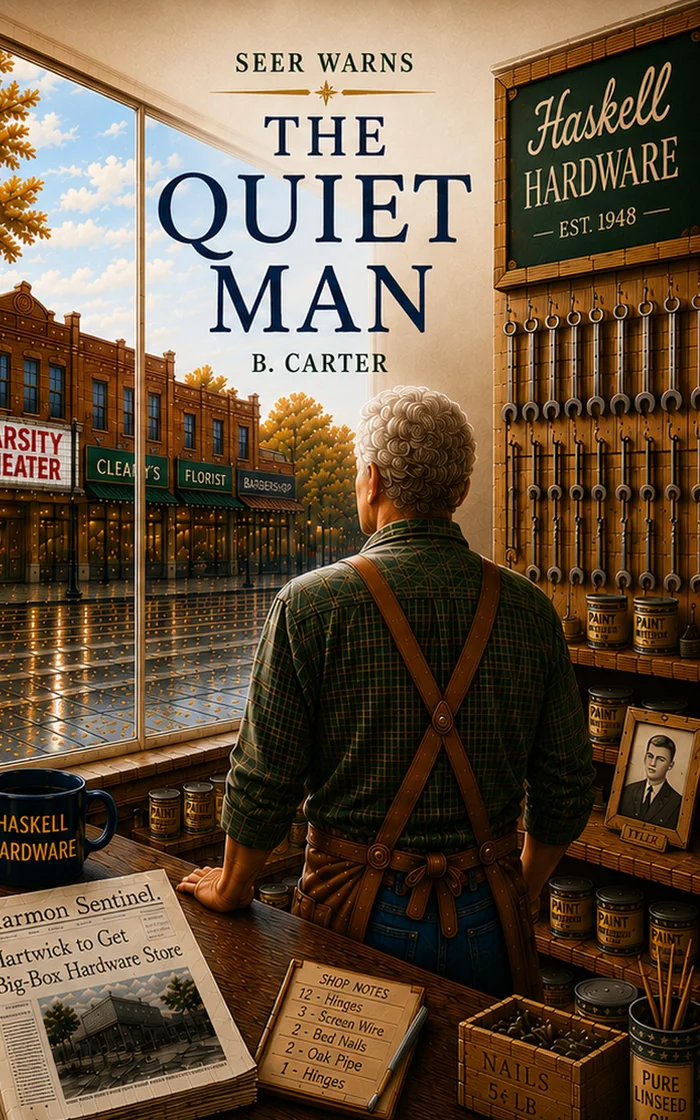
The cast.
Boyd Haskell, 56, is the one who kept the store open, thirty-one years behind his father’s counter. He reads materials the way other men read weather, gauge, grain, weight, the assessment always running. The wall he has built between himself and his grief is the wall a careful man builds, plumb and level, and it has held for eleven years.
Jean Haskell, 56, is the one who stood in the rain beside him, who found Boyd in the alley garage with the engine running and did not leave. Tyler Haskell is the son, 1995–2014, killed by an IED in Helmand Province, Afghanistan, three months from the end of his deployment and three months from coming home, nineteen years old; his highest pencil mark is age 17, 5′11″, and the oak stool was his from age five. Dale Haskell is Boyd’s father, who built the eighty-inch oak counter with his own father in 1971, hung the brass bell and the edging the same year, commissioned the sign lettering in 1982, and made the stool in 1989; he died in 2003. Emmett Haskell is Boyd’s grandfather, who raised the building in 1962, laid the brick, and laid out the apartment above where three generations of Haskells have lived. Walt Erickson, 61, twenty-three years on the floor, is the store’s voice to Boyd’s hands, the first thing the numbers say to cut and the last thing Boyd will. Mike, 64, is the lifelong customer who will drive to Hartwick anyway. Frank Luca is the one buying the last box.
The Seer is the old man in the diner, eighties, heavy flannel, white hair barber-cut, working hands enlarged at the knuckle and still on the Formica the way a tool is still when the work is done.
The Seer scene.
A Tuesday, 7 a.m., the Lamplighter, Boyd’s booth by the window. The old man is already in the seat no one sits in, which is impossible. The diner noise holds a half-beat, the coffee maker suspends mid-drip, the radio sustains a steel-guitar note between verse and chorus. He looks at the Formica, not at Boyd, and speaks in the level cadence of a man reading a materials list:
“It’s going to hold, Boyd. That’s the first thing. The store will hold for a while the way the store has always held. The materials are good and the framing is plumb and the wall you have built between yourself and your grief is the wall a careful man builds. It will hold long enough that you will believe it is holding.
“Then it does not hold. Not slowly. The savings go first … The building goes after the savings. The store and the apartment above it, the whole stack, signed over in a single transaction. You will sit at your kitchen table with a piece of paper, and your wife who loves you will sign it, and the loving will be the worst part of the signing. … Loyalty doesn’t survive the convenience, Boyd. Not when the convenience is every Saturday and the loyalty is a box of deck screws.
“Your wife will leave. Not in anger. She will ask you to come and you will not be able to come yet, and the yet will be the word she has been waiting through the years to hear. … The store closes anyway, Boyd. The stool. The pencil marks. The dent in the counter. It closes anyway. It just closes later. And it takes her with it.”
Then the one impossible specific: “In January 2008 you stood beside a ten-year-old boy who had fallen asleep on a stool in your store on a Tuesday evening, and you counted the seconds before you woke him. Sixty-three seconds, Boyd. You have never said the number to another person.” The man stands, lays three one-dollar bills flat on the counter, Boyd’s exact tip, and walks out; the booth seat is empty, the duct-taped vinyl undisturbed. On the counter is a three-dollar bill, a denomination that does not exist, which Donna clears with the plates without seeing.
The warned choice.
Loss A: keep the store open. Spend the savings down in the order a careful man spends them, sign the building away at the kitchen table while Jean signs beside him, watch the loyalty drain to the chain’s parking lot, and lose it anyway, later, with Jean lost in the same transaction.
Loss B: close it now, on his own terms, before it takes everything. Let go of the last room where Tyler existed, the stool, the marks, the bell, while there is still a marriage to carry out the door.
Boyd believes the old man, not because he is a prophet, but because the sixty-three seconds is the gauge and Boyd has read gauge for thirty-one years; the information matches the information Boyd already has. And still he takes his hand off the brick, opens the store at 8:00, makes the coffee, touches the highest pencil mark, and waits for the bell, because closing is a thing he would have to do, and the ruin is a thing that happens to him. The believing and the opening live in the same man at the same counter.
The fracture tell.
The stool, and the pencil marks. The store is a museum of one boy, the dent in the counter, the chipped scoop from the church yard sale, the door frame measured age 5 to 17. Boyd maintains all of it with a careful man’s discipline, the lock oiled, the brass polished, the marks touched every morning, because maintaining the room is how he keeps from saying the thing his body holds at the back of the tongue and counts to forty to swallow. When the marks come off the door frame and into a shadow-box frame, the reader knows the room is closing; where the frame ends up tells the reader what survived.
The outcome.
Pyrrhic survival. Everything the old man named arrives: the savings, the building, the chain, the kitchen-table signature, Jean driving south on Main while Boyd stands in the doorway and cannot yet come. The store closes. But the prophecy leaves the small unread space a builder always leaves. Boyd cuts the pencil marks out of the door frame, builds a shadow-box to hold them, and follows Jean ninety miles to Granger, to her apartment on Maple Crest Road with the radiator that works. He fixes the water pressure. He hangs Tyler’s marks on a kitchen wall in a town his son never saw. He takes a job at Petro’s Hardware because Dave needs a man who can hear the score, and Boyd is a man who can hear the score. The store is gone and the stool stays in the dark in Harmon, the last Haskell in the building. The marriage carried out the door. The boy traveled. Boyd traveled.
How it touches the other books.
Haskell Hardware is the series’ physical heart. Maggie Caldwell (The Loyal Daughter) comes to Boyd’s counter for structural screws and the news the chain is undercutting her crews; Dennis Reilly (The Loyal Man) comes for a true tape measure. The HomePlus drift up the highway is the same big-box hollowing that empties every book’s downtown, and Granger is where the series’ people go when Harmon can no longer hold them.