The cast.
Margaret “Maggie” Caldwell, 55, is a general contractor of thirty years, the first woman GC in Harmon County, with steel-toed Red Wings resoled three times. She reads a blueprint the way a pianist reads sheet music; her handshake closes deals and her word is her contract. She found the company dying and found a way to keep it alive, and the way was wrong, and she knew, and she signed anyway.
Earl Caldwell, 82, her father, started Caldwell Construction in 1971 with a pickup truck and a table saw, retired in 2004 when his back gave out, and lives in a cottage on Maggie’s property, still making furniture nobody buys, still trusting his daughter, not knowing the company is failing. Mike Stanton, 52, the foreman of eighteen years, has a wife, Jenny, with MS whose treatment is funded by the company’s insurance; he will do anything to keep the company alive until anything means the FBI and his wife’s coverage. Brenda Yates, 63, office coordinator since 1989, sees the Whitfield paperwork and says nothing, because she trusts Maggie. Paul Eckert, 48, a Harmon attorney who once represented the plant, fronts Whitfield Development Group LLC and its Granger backers, smooth and plausible, the money laundered through the construction process so cleanly Maggie can almost convince herself she doesn’t see it.
The Stranger is the man at pump 4 of the Shell station on Route 9. Mid-sixties, work jacket worn at the elbows, hands in his pockets. He says Maggie’s name the way you confirm an appointment, and his hands, when he takes them out, are still the way bedrock is still.
The Seer scene.
September 4th, 6:15 a.m. Maggie is fueling the company truck at pump 3, the Whitfield contract in the glovebox, the decision made at 3 a.m. over the spreadsheet. The man at pump 4 is not fueling, just standing. He names no date, no dollar amount, no agency, only the shape, and the canopy lights hum:
“You’ll sign the contract that’s in your glovebox. The money will save the company. Your crew will have work through winter. Your foreman will keep his insurance. … Then it stops feeling like that. They will not be from the state. They will come with a vehicle that is not marked. They will come with a woman who reads the books before they ask you the questions. … Your foreman will testify against you. They will use what your foreman cannot afford to lose. … Your father’s name. The name your father painted on a wood sign in a year when he had not yet learned to plan a sentence to fit the space. It will be in the federal indictment. The company will be gone. Your father will know.”
Then the one impossible specific: “You were eight years old when you noticed the C, Margaret” — the C on Earl’s hand-painted sign, drawn a little too large because he hadn’t planned the space, a thing Maggie has never said aloud to anyone. When she looks up, pump 4 is empty, no car, no footsteps, and at its base is a Wells Lamont work glove, size 6, the palm worn smooth, a fine dusting of sawdust on the cuff. She puts it in her pocket.
The warned choice.
Loss A: sign. The money saves the company through winter; the crew keeps working; Mike keeps Jenny’s insurance, until the unmarked car and the woman who reads the books, the indictment, Fenmore, the company gone, and Earl’s name in a federal document.
Loss B: don’t sign. Let Caldwell Construction die the ordinary death of a small firm in a hollowed-out county. Lay off the crew. Tell Earl. Take the boots off.
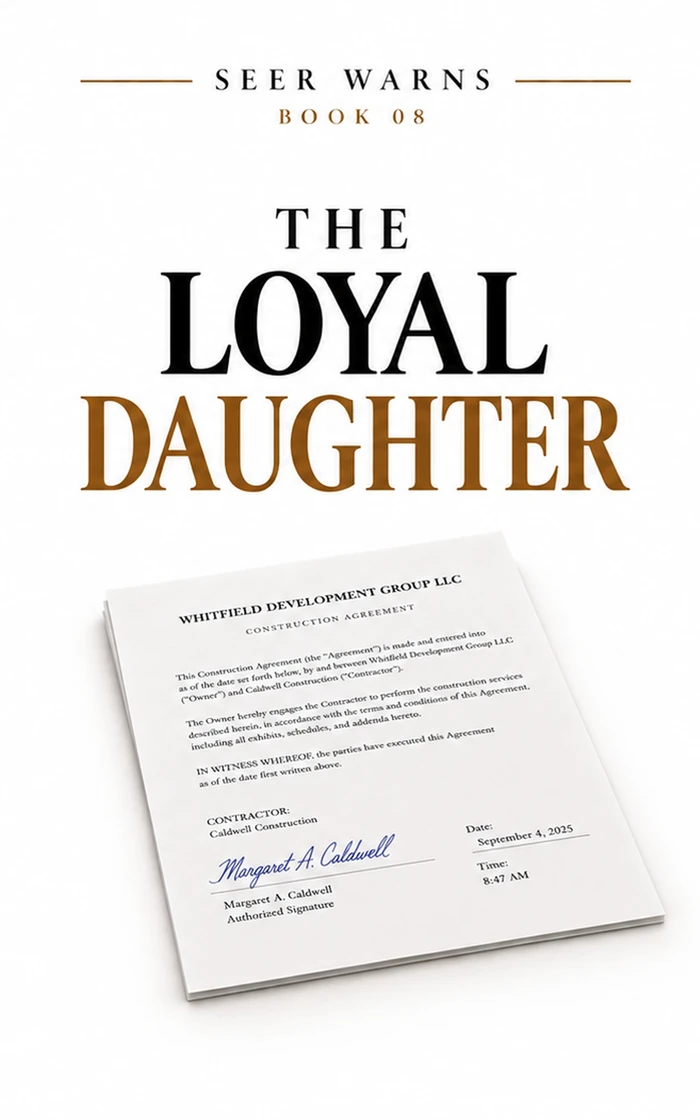
Maggie’s discipline is refutation, you refute a bad measurement by pulling the tape, and the tape is the C, and the C is exactly where the stranger said, which means he is not a guess. The tape says do not sign. She drives to the office, holds the sixty-cent pen over the signature line, sets it down, walks to the parking lot, comes back, and signs: Margaret A. Caldwell. September 4, 2025. 8:47 AM. Because Loss B is a thing she would have to do, and the trap is a thing that happens to her.
The fracture tell.
The boots, and the sign. Maggie’s Red Wings, resoled three times by an eighty-one-year-old cobbler on Main Street, are the discipline of a contractor whose margins never allowed replacing what could be protected, the same discipline she extends to the truck, the tools, her father. And on the kitchen wall hangs the sign Earl painted in 1971, CALDWELL CONSTRUCTION, EST. 1971, the C a little too large, the O she has touched every morning for twenty years. The book’s grammar is the gap between a contractor who measures twice and a woman who signed knowing the measurement said no, the federal indictment will call it willful blindness; it is already the phrase Maggie would use if she said such things aloud.
The outcome.
Pyrrhic survival. The contract springs the trap the stranger named. Mike testifies; the indictment comes in April; the case is United States v. Caldwell Construction; Maggie serves fourteen months at the federal facility at Fenmore. The company is gone, the license revoked. But she comes home: Earl’s cottage still on the property, the sign still on the kitchen wall with the too-large C, Brenda having cleaned the house and left a note and a plant on the porch, the Red Wings waiting in the closet for the oil they need. She laces them. They are the boots. She survived; the firm did not; her father knows, and her father is still there.
How it touches the other books.
Caldwell Construction sits directly behind Haskell Hardware, and Maggie comes to Boyd’s counter in The Quiet Man for structural screws and the news the chain is undercutting her crews. The attorney Paul Eckert and the AgriCore-shuttered plant tie back to The Honest Woman; her father’s permits surface in Ruth Calloway’s cabinets; and the Caldwell name turns up on the Little League fence in The Good Father.