The cast.
Neil Mercer, 52, is the surgeon other surgeons send their hardest cases to, twenty-one years at St. Clare’s, with hands that used to be still. He notices hands the way an ornithologist catalogues birds, involuntarily, and he recognizes in the stranger’s stillness the stillness his own hands once had.
Claire Mercer, 51, his wife of twenty years, is a pediatrician who noticed the tremor from across a kitchen island, the wine glass, the fork, and who has been quietly documenting it in the language a physician uses when the patient is the person she sleeps next to. Thomas Yeung, 9, is the patient scheduled for February 14th, a posterior-fossa tumor, a boy who wants to play soccer again; his mother Linda Yeung, 34, a single parent, brought a folder of research to the pre-op and said please. Ethan, the elder son, plays the cello (Bach, the Elgar) and is weighing Oberlin; he is the one who notices things the way a musician notices a wrong note, and the one who finally calls his father to ask, Are you okay? Like, actually. Kai, fifteen, plays basketball and texts in photos. Robert Mercer, Neil’s late father, a Main Street clinic doctor, is the one who watched a twelve-year-old reassemble a mantel clock and said you could do something with those hands. Sam Becker is the neurologist who said “probably stress” and came back months later to correct the answer. Lena Vasquez is the anesthesiologist, the best on the team, the one who will be in the room when the hand moves two millimeters.
The Stranger is in the cafeteria at six in the morning, mid-thirties, a face absent of social cues, no tray or cup, sitting the way people sit in airports. His hands rest on the Formica placed like instruments on a Mayo stand, six inches from Neil’s own.
The Seer scene.
Six a.m., the cafeteria a third full, Neil at his usual table with black coffee and the Hartwick Gazette. The man sits down; the espresso wand’s hiss sustains without falling, the code-blue chime holds its second tone, an ice cube hangs an inch above the bin. Then the man speaks, flat and precise, the way a surgeon dictates an operative note, and names no date, no name, no measurement except the count of months and seconds:
“The boy on your schedule. The approach will be the approach you have already chosen. … There will be a moment, during the resection of the medial component, when your right hand will do what your right hand has been doing for the months you have not been writing down. Not long. The duration of a held breath. … The boy will survive the surgery. His mind will be intact. … By the time he should have been playing the sport he came to you to play, he will not be walking unassisted.
“There will be a lawsuit. The mother’s attorney will subpoena what you have looked up at home in the dark. … Your wife will not leave you over the case. She is a physician. She knows complications happen. … She’ll leave you over the lie. She has been documenting. She has not told you. She is waiting for you to tell her.”
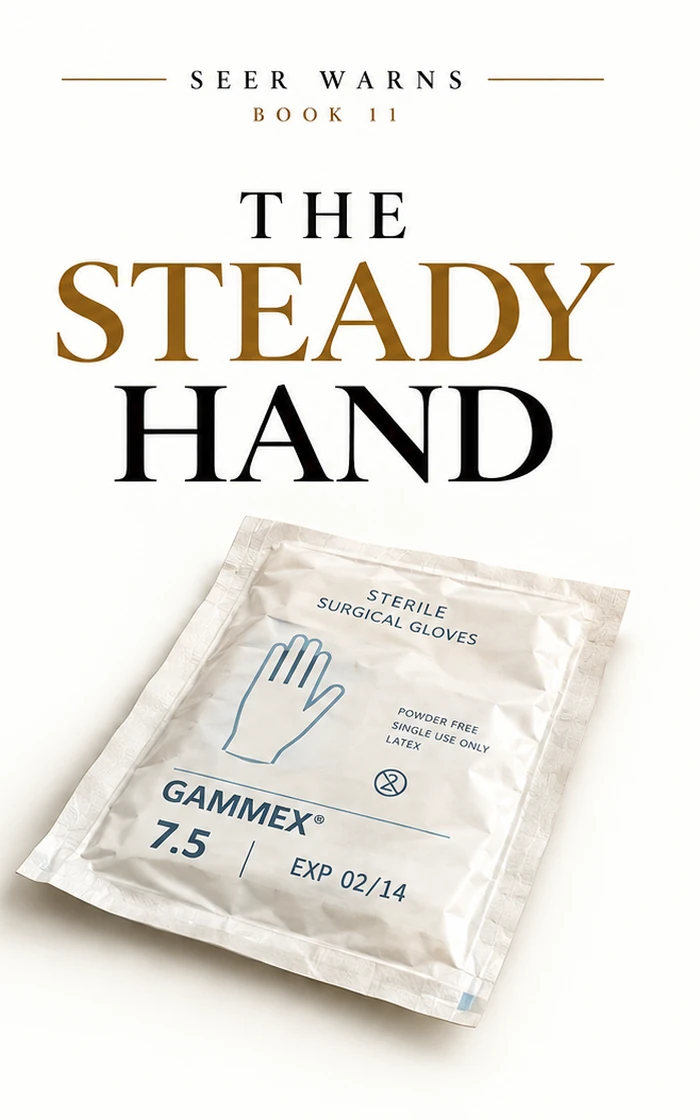
Then the one impossible specific: “On a Tuesday last September, during a meningioma resection, your right hand trembled for three seconds at the falx. … The three seconds is in your head. The three seconds is nowhere else.” The man sets a sealed Gammex glove, size 7.5, on the table, EXP 02/14, the date of the surgery. Neil blinks; the chair is empty, no footsteps, no scrape; the glove is real, fourteen grams, and not from any glove box in the hospital. He puts it in his desk drawer. He does not cancel the surgery.
The warned choice.
Loss A: keep operating. Take the Yeung case, scrub in on February 14th, and let the held-breath tremor arrive at the fourth ventricle exactly as named, the slip, the boy in a walker and then never walking unassisted, the lawsuit, the subpoenaed search history, the suspended privileges, the wife who leaves over the lie.
Loss B: report it. Walk into the chief’s office, trigger the mandatory evaluation, end the surgical career not with a retirement dinner but a meeting, become a man who used to be a surgeon.
Neil chooses Loss A. He keeps the sealed glove in his drawer, studies the imaging, and does not call Sam Becker, because being a surgeon is the only thing he has been since he was a boy, and stopping is a thing he would have to do.
The fracture tell.
The hands, and the two mugs. The amber scrub ritual, the still hands, are Neil’s whole identity; the book tracks the hands from instruments of precision to objects that, at his sides, do nothing while his trained mind still draws the incision line over a journal cover. The marriage is tracked through the 6 a.m. ritual, two mugs, two sugars, cream for hers, black for his, fifteen minutes of silence on two stools. When Claire’s stethoscope mug is gone from the counter, the reader knows: the confrontation told him she was leaving; the missing mug told him she was gone.
The outcome.
Complete collapse. The slip happens at 11:47 on February 14th, exactly as named. Thomas survives, impaired. The malpractice suit comes; the discovery produces the queries Neil typed to himself in the dark; the privileges are suspended, the board opens a file, the insurer settles. Claire stands beside him through the case, and then leaves, not over the error, over the concealment she had been documenting and waiting for him to confess. He ends a man who walks Pinewood in the afternoons, reads novels because their problems are not surgical, puts the last journal in the recycling, and makes one cup of coffee, black, two sugars, on one stool, the badge in the kitchen drawer looking up at the ceiling.
How it touches the other books.
One of St. Clare’s four hospital books. Cat Brennan (The Tired Mother) crosses Neil on the skybridge, reading the surgeon hiding his tremor, “the patient always says the same word: fine.” Dr. Patricia Alvarez, the palliative-care attending shared across the hospital books, works the floors where Neil’s work ends; the word fine rhymes with Cat’s book and the word please waits in The Merciful Nurse.