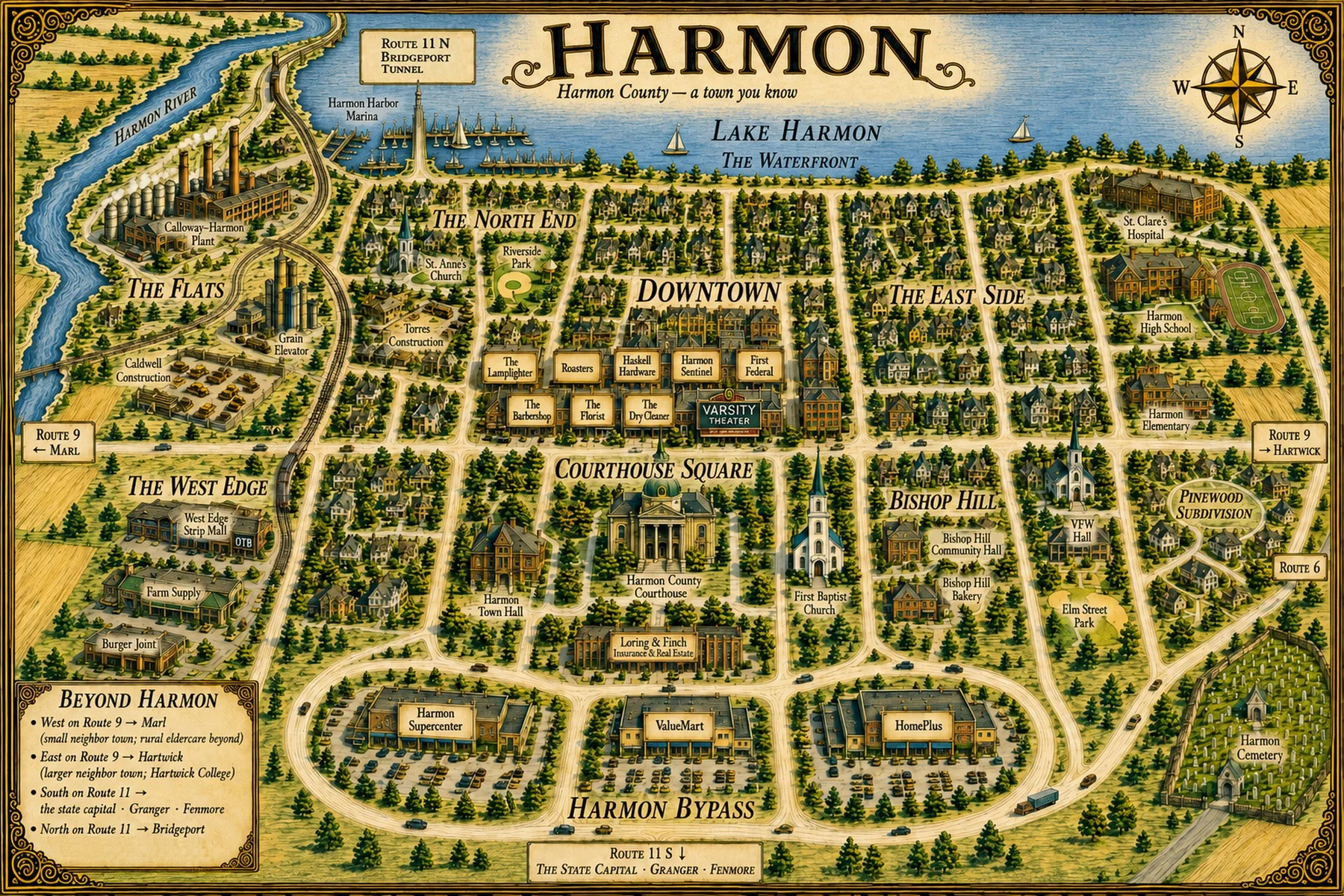
What it is.
Harmon is a Rust Belt county seat that could be in Michigan, Ohio, Pennsylvania, Indiana, anywhere a single employer carried a town for three generations and then began, slowly, to let go. The series never names the state. That is deliberate. The reader supplies the specificity; the town supplies everything else.
It is a grid town, laid out by nineteenth-century surveyors. Main Street runs east–west, the spine of downtown; Washington Street runs north–south. Their intersection, Main & Washington, is the center of town, and every address in Harmon climbs outward from it. The lake is the northern boundary; the Calloway–Harmon plant and the Harmon River are the industrial northwest; the big-box stores and fast food are south on the bypass, the modern sprawl that hollowed the old core.
The wound under everything.
The Calloway–Harmon plant, a pork-processing plant in the Flats, along the Harmon River, was the town’s engine and largest employer: roughly six hundred workers at its peak, two hundred on the night shift. The 2017 cuts were the first deep wound. The plant’s second crime, the one The Honest Woman uncovers, was twenty years of falsified water reports, cadmium discharged down the river into Lake Harmon, the town’s drinking water and its public beach. The plant closed in December 2024, after the Sentinel exposé. The night-shift glow and the constant low hum off the Flats are sensory fixtures of nearly every book; their absence, in the later ones, is louder than the hum ever was.
This is why the people of Harmon are vulnerable to a warned choice. When the engine of a town goes quiet, ordinary people are left financially and emotionally exposed enough that a stranger’s warning can name a real and arriving loss. The plant is the reason the Seer always has something specific to say.
The districts.
Downtown, Main Street between Mill and Park, the historic core, half-vacant now. The Lamplighter, Roasters, and Haskell Hardware run east in that order; the courthouse and town hall sit on Courthouse Square just south of Main.
The North End, the oldest neighborhood, up by the river, on a numbered grid (First through Fourth Street) the surveyors laid first. Small hundred-year-old houses on close-set lots; the most modest housing in town. A long-established Mexican-American community is anchored here by St. Anne’s parish. The Marsh house (The Good Father) and the Torres house (The Lawyer Daughter) are both here.
The East Side, east of Church Street, the newer half: St. Clare’s Hospital, Harmon High, the residential tree-streets (Oak, Elm, Vine, Walnut, Pine, Birch, Maple), the 1990s Pinewood Subdivision, and the older German-American neighborhood of Bishop Hill.
The Flats, low ground along the Harmon River, northwest: the plant, the grain elevator, the rail spur, the fairgrounds, working-class housing. The waterfront, north of Water Street: the marina, a small park, the public beach, a few newer condos. The West Edge, where Route 9 enters from Marl: the grain elevator, the farm supply, the burger joint, and the strip mall with the OTB, The Good Father’s gambling geography.
The roads out.
Route 9 is the local east–west road, west to Marl (the smaller neighbor, and the rural eldercare facilities beyond it), east to Hartwick (the larger town, with the college and the regional license bureau). It becomes Main Street through town. Route 11 is the long-haul north–south spine, the road characters take to leave the county: south to the state capital, Granger, and the federal facility at Fenmore; north out of town and down into the lake tunnel toward Bridgeport, five hours away. Route 6 is the eastern back road, the one The Accused Man leaves and returns on.
What the town is in the books.
Harmon is not a backdrop. The books are not set in Harmon the way a play is set on a stage. The town is one of the protagonists, the one that does not get a name in the eyebrow but appears in every chapter. A location named once is the same location every time: the third booth at the Lamplighter, the third teller window at the Hartwick license bureau, the eastbound Route 22 bus, the end of the marina dock at dusk. The surgeon you meet in the background of one book is the one the stranger sits down across from in another. Read all twenty and you see one town, one timeline, one community, accumulating.
What it is not.
Harmon is not a real town. The county is not a real county. The plant in the Flats has never existed, and the state it might be in is never named. Readers who write to the imprint claiming to be from Harmon, or to have driven through it on the way to somewhere, are read with interest and filed without reply. The town exists where it has always existed, which is in the booth across from you, the moment you sit down.