The cast.
Jack Callahan, 50, is the one who drove back. A carpenter in Granger, twenty-five years since Harmon; the hand that holds the hammer used to be the hand the town watched. He trusts his competence because the work is the only identity that survived the verdict.
Rose Callahan is Jack’s mother, seventy-eight years compressed into a 6:30 a.m. phone call, who called every Sunday at 6:00 p.m. until she couldn’t. Amy Weston is the girl, twenty-five years gone, the body found during Jack’s visit, not where anyone expected. Helen Weston is Amy’s mother, who carried the other half of the weight. Billy Crawford is the friend, the other name in the story that was never a case. Patricia Torres is the cafeteria worker who carried a page about Amy in a drawer for twenty-nine years, afraid, and finally delivers it on the porch.
The Seer is the man at the rest stop, sixties, a heavy flannel jacket, hands still at his sides, present in the placed, composed way that says the next thing is coming.
The Seer scene.
The rest stop on Route 11, twenty minutes from Harmon, the geographic threshold between the exile and the return. The man at the next pump speaks to the gas display, not to Jack, naming no date, no name, no height, only the shape of the days ahead:
“Your mother will go in the days you are here. You will be beside her. … The hand will go from warm to cool. The cool will be the moment. The funeral will be at the church she went to. The room will not be full. … the small count will tell you which of your neighbors were able to separate the mother from the son.
“The girl died of a fall from the ledge above the town. … No second person. No placement. A fall. … The death was an accident. There was no crime. There was never a crime. The report will be public. The case will be closed. Not cold. Closed. … The closed means: we know. The knowing is: accident. Fall. Alone. Not you.
“You will drive out on the same road. … This time you will not check the rearview mirror. Not because the town has changed. Because you have.”
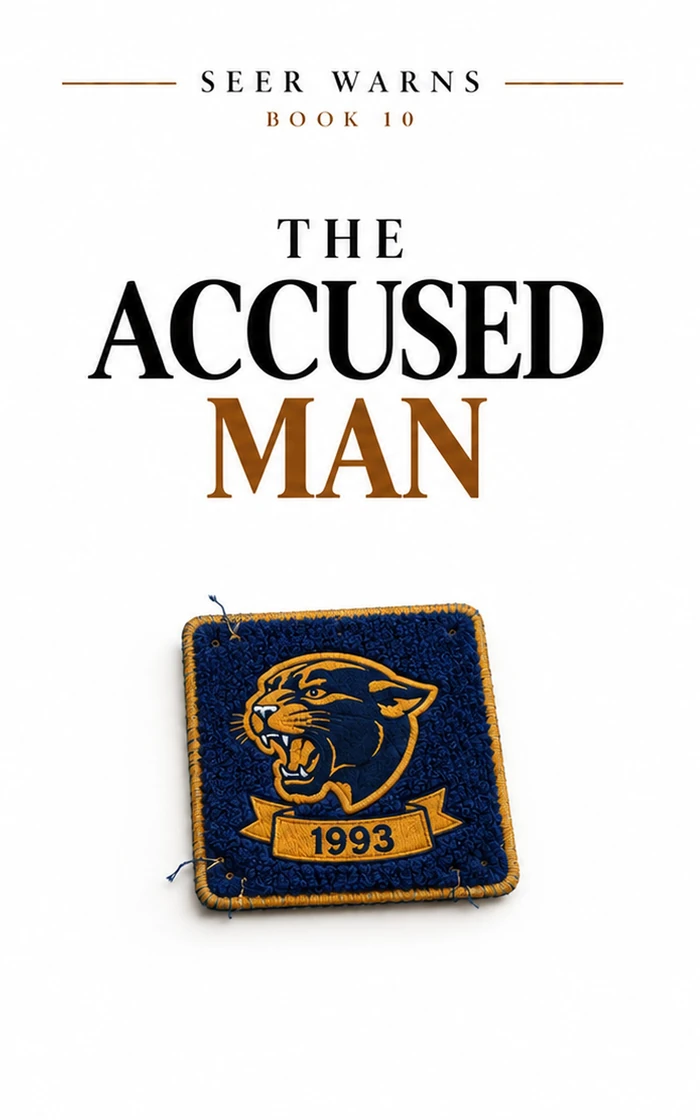
Then the one impossible specific: “She was in a blue tank top, Jack. … She said I’m disgusting, don’t look at me. You said You look fine. … The exchange has lived in your head for twenty-five years without leaving your mouth.” The man sets a small cloth patch on the concrete, chenille blue and gold, a Panther mascot, the banner reading 1993, Amy’s varsity patch, cut cleanly from her jacket with a seam ripper by someone who knew clothing and carried it for twenty-five years. The man’s truck pulls out east; pump 4’s display reads $0.00, never used. Jack puts the patch in the pocket closest to his heart.
The warned choice.
This is the series’ inversion: the man does not warn Jack against an action, he tells him the shape of a vindication. The only choice left is whether to drive the last twenty minutes into the town that took his life, to be beside his mother when the hand goes cool, to sit in a half-empty church and count the neighbors who could separate the mother from the son, and to stand in Harmon when the bones on the north face of the hill finally say accident, fall, alone, not you.
The alternative is to turn around, stay in Granger, keep the geography that was his only verdict of innocence, and let his mother die without him rather than face the town that convicted him without a trial. Jack believes the man because the two sentences from the booth are the gauge, and no one alive could know them. He drives west.
The fracture tell.
The rearview mirror, and the hands. For twenty-five years Jack has driven looking behind him, the carpenter’s grip at ten and two the only thing he trusts. The book tracks the exile in the mirror-checking and the freedom in its absence; the man’s promise, that on the way out Jack will not look back, not because the town changed but because he did, is the measure of what the week costs and what it returns. The hands that hold the hammer, that used to be the hands the town watched, become, by the end, just a working man’s hands.
The outcome.
Pyrrhic survival. Everything the man named arrives: Rose dies with Jack beside her, the funeral is half-empty, a clearing crew finds Amy’s bones on the hill, the forensics say a fall, alone, no crime, and the case is closed, not cold, closed. Some of the town nods; most turn; no one apologizes, because the conviction was never a legal event and legal events are the ones that produce apologies. But the prophecy gives back what twenty-five years took: the innocence restored on the public record, the page Patricia Torres finally carries up the porch steps, and a life Jack begins to rebuild in Harmon, consulting at the dock, the writer’s questions, the slow return. He lost his mother and a quarter-century to a crime that never happened; he drives out the last time without checking the mirror.
How it touches the other books.
Jack’s exile to Granger and return is the same Harmon-and-Granger axis the series’ displaced people travel, Boyd Haskell in The Quiet Man, David Rourke in The Silent Pastor. The Lamplighter, Donna, the Sentinel and Hannah Calloway’s reporting, and the plant’s long shadow tie the exoneration to the wider town record the series keeps.