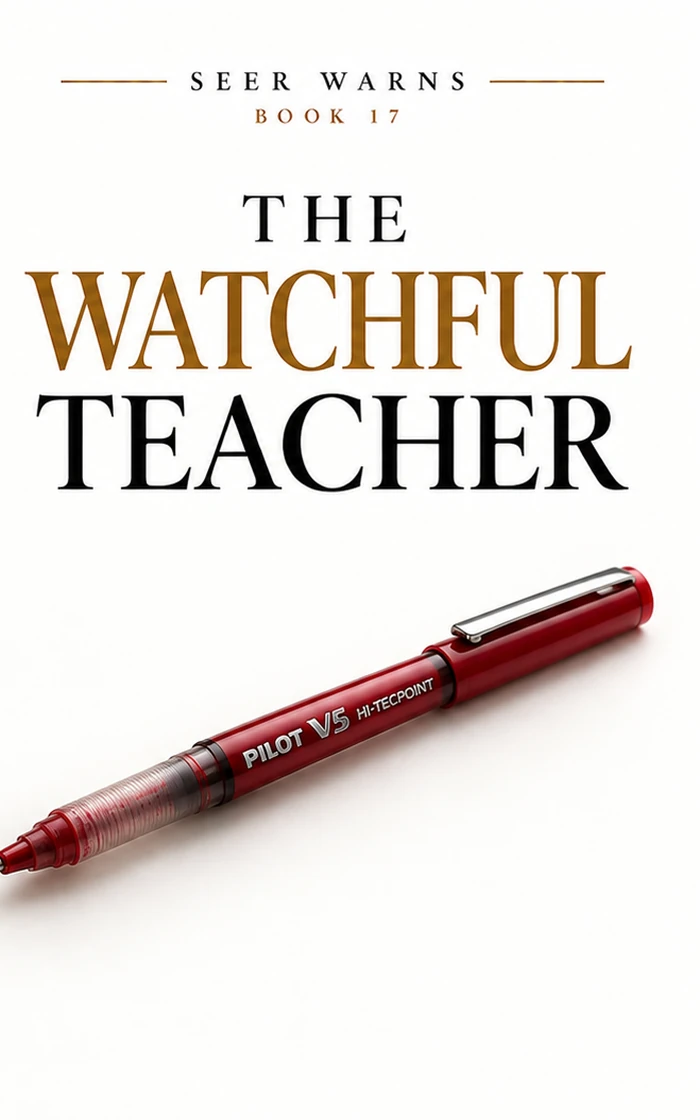
The cast.
Warren Gibbs, 50, is the one who walked up the porch anyway. English, Room 14, twenty-six years, the teacher who reads the subtext his students cannot write anywhere else. He carries a red Pilot V5 the way a doctor carries a stethoscope; the margin note is his instrument.
Jess is the student, third row, left side, seat by the window, who writes essays about locked doors and pulls her sleeves down when the classroom is warm. Dale Harlow is Jess’s father, First Baptist, reads scripture, cousin of the sheriff, calls him brother, and controls his force, closing a door without slamming it. Linda works the diner, Warren’s Saturday biscuits. Cheryl Romero is the investigator who, unlike the desk that twice returned unfounded, actually reads, the one who later delivers the word FOUNDED.
The Seer is the woman at the gas station, fifties, fleece and work boots worn from standing on hard surfaces, hands still at her sides at a pump that is never running, the gas cap off, the display at $0.00. She was never buying gas.
The Seer scene.
A Saturday morning in March, the Kum & Go on Route 9, pump 3, the river smell coming up the bluff. The woman at pump 4 speaks to the pump display, not to Warren, in the exact register Warren uses on a text, reading, subtext, performance, margin notes, the box on the form, the system as a text-reading machine:
“You take attendance twice. The first does not count. … The second is the reading. Bodies, then states. … You will read again. The report will go to the same desk it has gone to twice. The same reader will read the same text. … The machine will return the word it has returned the two times before.
“After the third reading, the girl will come to your room with the kind of injury an emergency room asks questions about and that has been splinted at home because at home no questions are asked. … You will go to the house. You will walk up the steps the story has always been. … The man will call the sheriff. The sheriff is the man who calls the man brother and means it. … You will be arrested. Your license will be suspended.
“The girl’s situation will get worse. … The girl will be pulled from your class. … Inside Room 14, you are the teacher. Inside the house, you are a trespasser. The system put the wall between you and the child. You will try to climb the wall. The wall is the system. The system is the protection and the obstruction and both are the same wall and the child is on the other side.”
Then the one impossible specific: the second attendance, the bodies-then-states reading Warren has never told another adult, not his wife, not the principal, never written down. The woman drives off in a mud-fendered Ford Ranger; on the concrete where she stood is a red Pilot V5, fine-tip, identical to Warren’s own down to the molded ridge on the clip, except the ink is dry. He caps it and puts it in his shirt pocket beside the one that still writes. One pen wrote. One didn’t. Both are his now.
The warned choice.
Loss A: walk up the porch. Say the words he has been holding in the margins since the seating chart assigned Jess to the third row, get arrested on a porch he was not invited onto, lose his license to the same district reading that twice returned unfounded, and watch Dale pull Jess out of school entirely, behind a wall the man controls and Warren cannot climb.
Loss B: stay inside the system. Keep filing reports to the desk that does not read, keep writing margin notes the machine will not read, watch the girl in the third row and do nothing the form does not permit, and let the performance be the lock that has held since she learned to perform.
Warren believes the woman because the second attendance is the gauge and no one outside Room 14 could know it. And he walks up the porch anyway, because filing one more unread report is a thing he would have to do, and the caring outside the system is the thing that happens to him. The cruelty is that both readings are true: he is right about the girl, and walking up the porch makes it worse.
The fracture tell.
The sleeves, and the two pens. Long sleeves in warm weather are the four words that are the indicator, the thing the teacher reads and the system does not, because the teacher reads classrooms and the system reads living rooms. The book tracks the cost through the double weight in Warren’s pocket: the pen that writes and the pen that ran dry, the teacher he is today and the teacher the system will make of him. When the dry pen’s weight stops mattering and a new V5 writes in the margin again, the reader knows what survived the suspension.
The outcome.
Pyrrhic survival. Everything the woman named arrives: the third unfounded, the injury, the porch, the arrest, the suspension, Jess pulled behind the wall. Warren cannot save the girl he set out to save by going outside the system. But the prophecy leaves the unread margin a teacher always leaves. Reinstated, Warren learns the slower truth, that the wall is also a door if you keep filing the reports and writing the margin notes until an investigator who actually reads, Cheryl Romero, arrives to deliver the word FOUNDED for the next child. The book ends in Room 14 with a new student in the second row wearing long sleeves at 78 degrees, and Warren picking up the red pen. The knowing is the teacher. The knowing is the cost. The knowing is the thing that does not run dry.
How it touches the other books.
Harmon High is the series’ schoolhouse; Warren’s reading of children rhymes with Cat Brennan’s reading of bodies in The Tired Mother, the word both keep meeting being the patient’s, and the student’s, fine. Jess’s pro-bono attorney is Edward Brennan-Loring, nephew of Anne Loring (The Design Partner), the same lawyer who will later defend Luisa Dominguez in The Merciful Nurse, the witness-defense network the series quietly builds. Maureen Reilly, the Cooper-Crawford third-grade teacher in Cooperville, carries the story outward, and the Pine Ridge reading program threads through the later books.