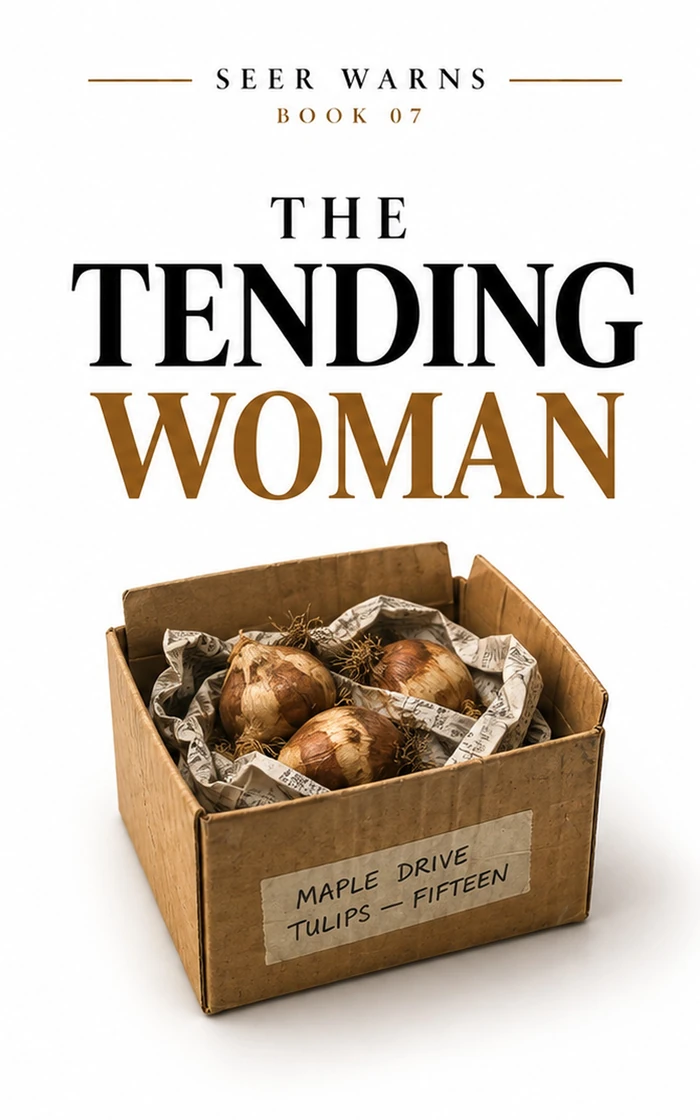
The cast.
Elena Voss, 68, is a retired librarian who has spent thirty years in the garden on Maple Drive and three years a widow. She catalogs the world so it cannot surprise her, and the great proof of it is that she knows which of the bed’s tulips are hers and which are her husband’s, and that no one else can tell. Her reliable, uncataloged love is the lever her son’s need keeps pulling.
Martin Voss, her late husband, planted eleven of the fifteen tulips before his heart stopped in October, and said, at the end, keep it. He managed the money because he understood that care has a cost and the cost has to be funded. Adam Voss, 32, is the son who calls crying, who acts like he comes from money because Elena never let him know he didn’t. Sandra is Adam’s partner, bright and ambitious, who says the words “family investment fund” on a phone call in June. Dossy (Dostoyevsky) is the gray tabby who sits on the counter because Martin used to shoo him off and Elena won’t.
The Seer is a woman at the Saturday market on Oak Street, in a sun hat, reading glasses on a beaded chain, standing at Carol’s jam table with her hands perfectly still in a place where every hand is in motion. She speaks without looking at Elena, looking instead at the rows of peach and apricot and fig.
The Seer scene.
9:00 a.m. at the market, the folk guitarist on the corner playing James Taylor. The woman beside Elena names no date, no name, no amount, only the shape of the whole arc, in the cadence of a librarian reading a call number:
“You’ll wire your son the money. You’ll do it from the kitchen table, on the laptop, in the sunlight, with the cat on the counter. You’ll feel brave. You’ll feel like Martin. … He’ll settle his debts. He’ll get a new apartment in a neighborhood he can’t afford. He’ll sound like your son on the phone. You’ll think: it worked. … Then a stranger will call your phone. A woman, bright, professional. She will use a phrase that contains the words family and fund. … The venture will fail. Your son will call you again. You will say: I don’t have it. The silence on the phone after you say that will be the longest silence of your life. … You’ll be seventy in a one-bedroom apartment that smells like dry-cleaning chemicals, with a cat and a box of tulip bulbs you can’t plant and a son who calls less often because guilt sounds like your voice on the phone.”
Then the one impossible specific: “After he was on the floor, Elena, you finished the row. Four bulbs. … You have never told another person which four were yours.” The woman sets a glassine seed packet on the table, hand-lettered in pencil: Tulipa — Red / Yellow alternating. Four bulbs. When Elena looks up, the woman is gone the way a word is gone when the page is closed.
The warned choice.
Loss A: keep sending it. Wire the money, cosign the next thing, refinance, sell the house out from under herself one perennial bed at a time, until she is seventy above the Crane Street dry cleaner with a box of bulbs she can’t plant.
Loss B: stop. Say to Adam the word a good mother is not supposed to say. Let him fall, or fail, or be angry, and keep the house, the garden, the version of motherhood she has built her widowhood around, at the cost of believing she is still good.
Elena keeps sending it. The trap is that the virtue is the vulnerability: her reliable generosity is exactly the lever Adam’s need pulls. The Seer does not tell her what to do; she tells her what saying yes will cost, and lets Elena decide whether being a good mother is worth the house her husband’s money built.
The fracture tell.
The garden, and the row she finished. The book reads Elena’s decline in the beds, the dahlias neglected, the bulbs lifted into a cardboard box with newspaper between the layers, the raised beds emptied. The deepest tell is the four bulbs she knelt and planted in the holes Martin had already started the day he died, the four she has never named to anyone. When the garden goes into a box, the reader knows the house is going; when, at the end, she plants again in pots on a Crane Street fire escape, the reader knows what survived.
The outcome.
Pyrrhic survival. Elena wires Adam $340,000; it buys a rescue that looks like a rescue, then Sandra’s phone call, then the collapse, then the empty account and the sold house. She downsizes to a one-bedroom above the Crane Street dry cleaner, learning to stop smelling the chemicals the way she once learned to stop hearing Martin’s workshop fall silent. But the prophecy bends: the crisis Elena thought she was preventing is the thing that finally makes Adam grow, $22-an-hour warehouse work, therapy with Dr. Natalie Harrison, a son becoming the adult she hoped for. The book ends on a Sunday morning in May, the dry cleaner closed and quiet, the deadheaded tulips in pots on the fire escape, a sparrow she has named Phil, the cat on the railing, and the phone ringing with a new gentle ringtone: ADAM. “Hi, Mom.”
How it touches the other books.
Elena’s descent from the Pinewood bungalow on Maple Drive to the Crane Street walk-up is the town’s class geography in one widow’s year. Crane Street is the low-rent side that also holds one of Kevin Reilly’s laundromats (The Loyal Man); the Saturday market and the public library are shared civic ground; and the ValueMart she starts driving to instead of Main Street is the same big-box drift that hollowed every book’s downtown.