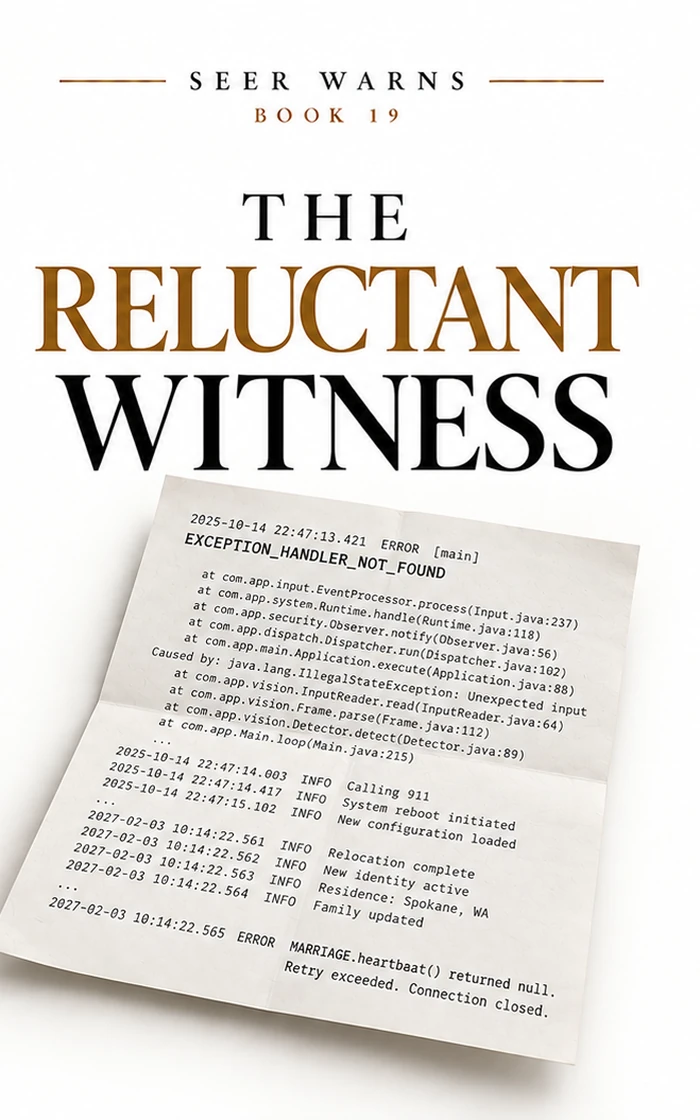
The cast.
Rachel Kim is the witness, a software engineer who reads the world through a perception filter, inputs in the order they arrive, and who has never told anyone she thinks in stack traces. The murder is the input her life had no error handler for.
David Kim is the husband, a construction project manager, who will say the sentence about whose fight this is, at the kitchen counter, over coffee gone cold, and who will follow because he stays, and resent because he never agreed. Mia, 7, is the daughter at the age that adapts, who will take the new name as her name. Sophie, 5, is the daughter at the age that asks, why is my name different. Marcus Webb is the prosecutor. Jeff Carver, 45, is the U.S. Marshals liaison who turns the Kims into the Collinses. Caruso is the man with the scar.
The Seer is the man on the stone bench beside the courthouse steps, fifties, nondescript clothing, hands on his knees, still in the zero-state way an input holds before the processing begins.
The Seer scene.
Rachel on the courthouse steps with the killer’s face in her memory, deciding whether to walk in to the DA. The man on the bench speaks to the courthouse door, not to Rachel, in the cadence of a system log, naming no date and no name:
“You think in stack traces. The parking lot was the input. The input had no error handler. … You crashed. You rebooted. … You called 911. You have not told anyone that you think this way.
“You will testify. You will identify the face. … The jury will believe you because you are a software engineer and software engineers are precise … The conviction will send the man to prison. … The names change. The changing is the protection. The protection is the cost.
“The husband will follow because the husband loves you … But the following is not the agreeing. … The marriage will survive the move. The marriage will not survive the resentment. The resentment is the question: who decided this was our problem? The answer is: nobody decided. You were in a parking lot. A streetlight happened. … The testifying is yours. The cost is the family’s.”
Then the one impossible specific: the stack trace, the framework Rachel uses to read her own life, the absence of an error handler for the man falling, which she has told no one. The man leaves a printout on the bench, the fixed-width font from every terminal she has ever opened, the logging library she configured three years ago, an exception trace that begins at 22:47:03.184 the night of the murder and ends sixteen months later at a timestamp in a city she has never visited, in a house she does not own, in a name she does not yet have. The final line: MARRIAGE.heartbeat() returned null. Retry exceeded. Connection closed. When she looks up he has walked into the courthouse. She files the page in the slot for things she will carry in and not carry back out.
The warned choice.
Loss A: testify. Identify the scar, give the precise account the jury believes, send the killer to prison, give the dead stranger’s wife her justice, and pay it with the family’s whole life, the relocation, the new names, the schools, the house, the ceiling that comes from the wrong side, and the marriage that follows but does not forgive.
Loss B: stay silent. Keep the truth to herself, keep the Kim name and the Elm Street house and the marriage intact, and let a man with a scar walk free and a stranger’s widow go without the verdict, because the murder was never Rachel’s crime to answer for.
The series’ clearest statement of the trap: nobody decided this was Rachel’s problem; a streetlight happened. Testifying is the one decision that is hers, and the cost lands on people who did not decide. She believes the man because the stack trace is the gauge, a framework no one outside her had ever been inside. She goes in.
The fracture tell.
The code, and the ceiling. Rachel narrates her own life in inputs and outputs, conditionals and cascades; the murder is the exception with no handler, and the book tracks her by the system she keeps rebooting. The stack-trace printout is the figure for the whole novel, her private register made into evidence, ending in the null heartbeat. The new house’s ceiling, the streetlight from the wrong side, the nightly accounting of everything that changed, is where the cost lives after the verdict.
The outcome.
Pyrrhic survival. Everything the man named arrives: Rachel testifies, Caruso is convicted, the Kims become the Collinses and relocate to Bridgeport, and the marriage survives the move and dies of the resentment, David following and then leaving, exactly as the trace foretold. But the prophecy runs decades past the verdict. Mia adapts and thrives, becomes a technology leader; Sophie, the one who asked, becomes a therapist; Rachel builds a long, quiet life of witness groups and library reading programs, mentors a generation, and is honored across the years. She lost her name, her home, and her marriage to a stranger’s justice; she gained a family that grew whole on the other side of it, and a faith, finally, that the stranger’s family would have done the same for hers.
How it touches the other books.
Set largely in the valley city of Caldwell and the northern town of Bridgeport, where the series’ relocated people land, the same Bridgeport that holds Carmen and Luz in The Lawyer Daughter. The witness-group and reading-program threads, and the Pine Ridge and Lamplighter connections, tie Rachel’s long aftermath to the wider record the series keeps, and the prosecutor Marcus Webb recurs through the later books.