The cast.
Claire Novak, 44, is the one who knew the structure, a novelist who teaches Advanced Fiction: The Architecture of the Witness and has read all nineteen books on the shelf. She reads her own life as a Seer Warns text, in italics, in the protagonist’s chair while she is sitting in it.
Meg Novak, 41, is Claire’s younger sister, eighteen months sober at the start, who works at Crossroads Books in Marl and lives above the Pereira Bakery, the subject of the manuscript, the one whose answer Claire will not predict and will honor. Helen Novak, the mother, a retired teacher, who says the decision is not yours. Janet Ortega, Meg’s sponsor, the chain’s keeper, who carries a phrase from Luisa Dominguez’s grandmother. Richard Novak, 65, the father, a retired Ford-dealership parts manager who reads the Sentinel and not novels and says one sentence about each thing Helen tells him, always exactly the right one. Donna Pell, 67, who has owned Crossroads Books since 1991 and hired Meg out of her second treatment. Hannah Calloway, the Sentinel reporter who interviews Meg in the back room. Carmen Pereira, the baker below Meg’s apartment.
Around the publishing of the book stand Katherine Sumner, 58, Claire’s New York editor of six years, who makes the careful list of interviews Claire will and will not do; Madison Wills, 41, the cover designer who draws the pulled-out kitchen chair and the napkin on the floor before she understands what she has drawn; and Aaron Beckman, 57, the Times critic whose review is titled The Novel That Cut Its Own Center. In Claire’s Tuesday workshop is Maya Whitten, 22, her most careful reader, who asks the question about Meg the week before Roasters and, nine months later, finally asks her own grandfather. And the town keeps the book: Margie Pearson, 64, who has run the Lamplighter since 1995 and hides a spare hardcover under the counter, and Earl Henderson, 72, the Wednesday-meatloaf regular with a brother in Marl he has not spoken to in nine years. The whole town, Reilly’s, Haskell’s, the Lamplighter, gathered for the last book.
The Seer is the stranger at the corner table at Roasters, 8:53 on a Monday, fifties, practical clothing, hands still on the table, who speaks in the novelist’s own register and leaves the twentieth bookmark.
The Seer scene.
Claire is revising the Thanksgiving chapter, the novel’s center, when the woman sits down across from her. The world holds the half-beat Claire has read about nineteen times. The woman speaks to the table, in the weather-report cadence Claire has taught her students, and says the thoughts Claire is thinking, in italics, as she thinks them:
“You are thinking, right now, this is the warning. This is the beat. This is the Seer speaking. I know this beat. … You will submit the manuscript. The editor will call you. She will say — this is the best thing you’ve ever written — and the sentence will be correct because the novel is the truth and the truth is the sister.
“Now I will tell you the thing I have not told the others. You are not going to do exactly what they did. … You will not lose the sister the way the others lost the wife and the brother and the daughter and the partner. You will lose her differently. The losing will be smaller. The losing will be specific. The losing will be twelve pages.
“The math you have read in nineteen books is two losses, one chosen. The math you are about to read is two losses, two carried. Both of you will carry.”
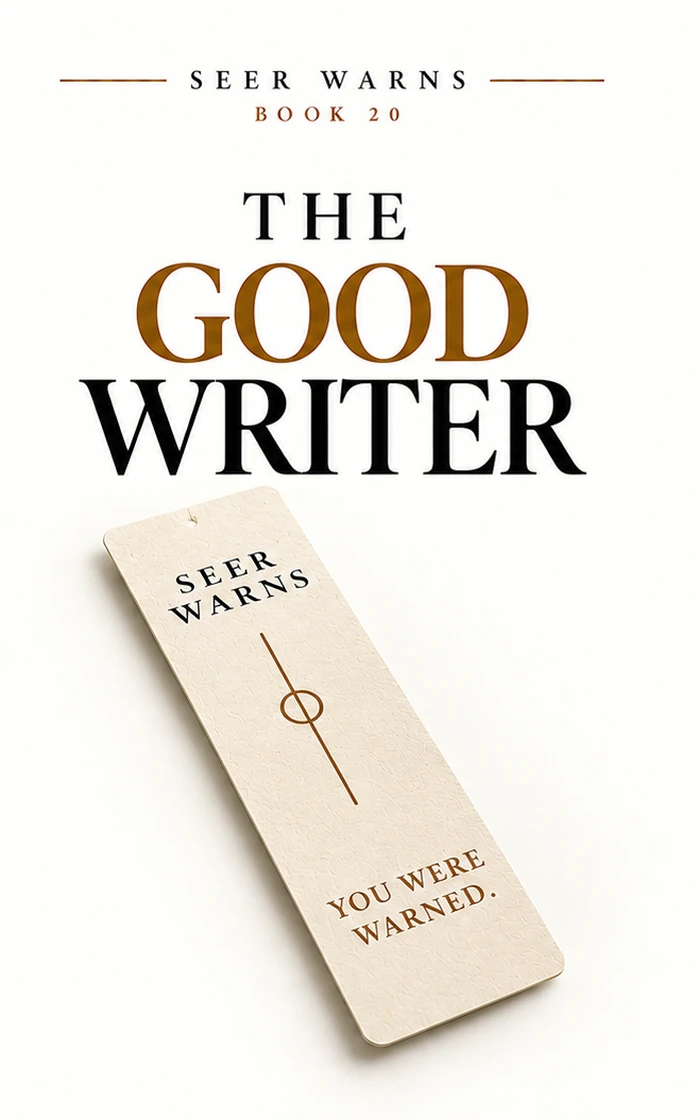
Then the one impossible specific: the italics themselves, Claire’s inner narration of her own life as a Seer Warns novel, thoughts with no audible form, inside Claire and nowhere else, which the woman speaks aloud as Claire thinks them. The woman foretells that Meg will read the manuscript first, take two days, and on the third day give permission not as a gift but as a cost, the keystone chapter cut, the book reaching the world twelve pages shorter with a hole the shape of the asking. She leaves a series bookmark on the table, You were warned, from the same print run as the eleven in Claire’s drawer. The twentieth.
The warned choice.
Loss A: publish the novel as written. Submit it, hear the editor’s sentence, walk through the acclaim, and lose Meg the way nineteen protagonists lost the people they loved, her worst years rendered better than she could render them, the phone that stops ringing, the sister gone.
Loss B: don’t publish. Keep the sister, put the best thing Claire has ever made in a drawer, and live with the silence where the book would have been.
But Claire does the thing no protagonist in the nineteen books before her did: she asks the wounded person what she wants before doing the thing the warning is about. The hesitation the Seer did not predict, the deciding that is the door, leads her to give Meg the manuscript. The third number enters the math: the cut. Meg gives permission as a cost; Claire cuts the keystone; the book publishes with the hole. Two losses, both carried, the asking-late, the doing of what the asked person says.
The fracture tell.
The italics, and the bookmark. Claire’s whole life is narrated in the craft vocabulary she reads the series with, and the Seer’s speaking of those italics aloud is the series turning its own instrument on its last reader. The bookmark left behind, the twentieth, matching the print run in Claire’s drawer, folds the series into itself: the book about the book, the pattern inside the pattern. When the keystone chapter goes into a folder Claire will not delete and will not reopen, the reader knows what the asking cost and what it saved.
The outcome.
Two losses, both carried, the series’ only true turn. Claire publishes, but not as written; Meg reads it first, asks for the cut, and Claire honors the asking. The book reaches the world in October twelve pages shorter, the hole the shape of what Meg chose. The reviewers notice; one drives from Caldwell to Marl to ask Meg why the chapter is missing, and Meg says it was her worst day rendered better than she could have rendered it, and does not let her face change, and goes to the back room, and calls her sponsor, and does not use, and is all right by Wednesday at seven, and calls her sister, and the call is the proof. The phrase Meg carries, el cargar carga, the carrying carries, is the same phrase Luisa Dominguez’s grandmother gave, and Claire, reading Book 17 by her study window that Wednesday night, finally sees the architecture she has been inside the whole time. Nineteen protagonists were warned and walked into the fire alone. The twentieth turned and asked, and so the loss was shared, and so it could be carried.
How it touches the other books.
The capstone. The Good Writer contains the whole series: Reilly’s, Haskell’s, the Lamplighter, the Sentinel and Hannah Calloway, Pereira Bakery, Marl and Caldwell and Bridgeport, and the chain that runs from Luisa Dominguez’s grandmother (The Merciful Nurse) through Janet Ortega to Meg. Claire has read and reviewed and taught the other nineteen, and the objects the Seers left, the bus schedule, the seed packet, the puzzle piece, the chenille patch, the brass ampersand, the white rose, the dry pen, all return here as the things she recognizes. Read it last; it is the book the series was always writing toward.