The cast.
James Ota, 42, is the one who gave the toast. A designer, he draws Nina on Sunday mornings while she reads and does not know, the pen the closest he allows himself to her, because the distance is the thing he has been designing all his life.
Nina Chen, 35, is the second wife, an architect at Brandt Architecture, the one he draws and the one who will see the blank page; she walks into a room and sees the weight distribution, the load paths, the difference between the wall that holds the building up and the wall that is decoration, and she builds only the load-bearing kind. Lily, 7, is James’s daughter, who carries an overnight bag between two houses and composes her face the way James taught her without meaning to. Allison Park is the first marriage, a Caldwell Elementary teacher James left for Nina, who has filed him the way she files everything: ex-husband (see also: Lily’s father; affair). Dr. Patricia Kemp is the therapist who named the thing in fourteen months of sessions, you don’t have an affair problem, James, you have an intimacy ceiling. Yuko and Sean are James’s parents, the contained mother and the father who left on a Tuesday after dinner when James was eleven, the two architectures the wall was built from. Miso is the dog with the undignified name, the one Nina laughs at, the laugh that is the marriage and is real.
The Seer is the woman at the florist, late sixties, a practical gray cardigan, hands resting still on the glass display case the way elements are placed on a page, the stillness of a page before the print run starts.
The Seer scene.
The florist on Main Street, the day before the wedding, James picking up Nina’s white roses. The woman at the counter speaks to the roses in the case, not to James, in the exact register James uses on a project, brief, deliverables, composition, intermediary, negative space, the load-bearing and the decorative, wall:
“You draw her on Sunday mornings. … She does not know she is the composition. The drawing is the closest you allow yourself to her, because the pen is the intermediary, and the intermediary is the distance, and the distance is the thing you have been designing your entire life.
“You will marry her. The vows will be real. … Then the work will be the room. … The studio is the room where being alone is the work and the work is the excuse and the excuse is the wall. … The choosing is the withdrawal. The withdrawal is the wall. … You will answer with a sentence you have revised. The sentence will be the wall in the smallest number of syllables.
“The wife will leave. There will be a note on the counter in the architect’s handwriting. … You will know you did it on purpose. You will have seen it coming from the rehearsal dinner. … The truth is you did not let it happen. You made it happen. Because the wall is not a symptom. It is you.”
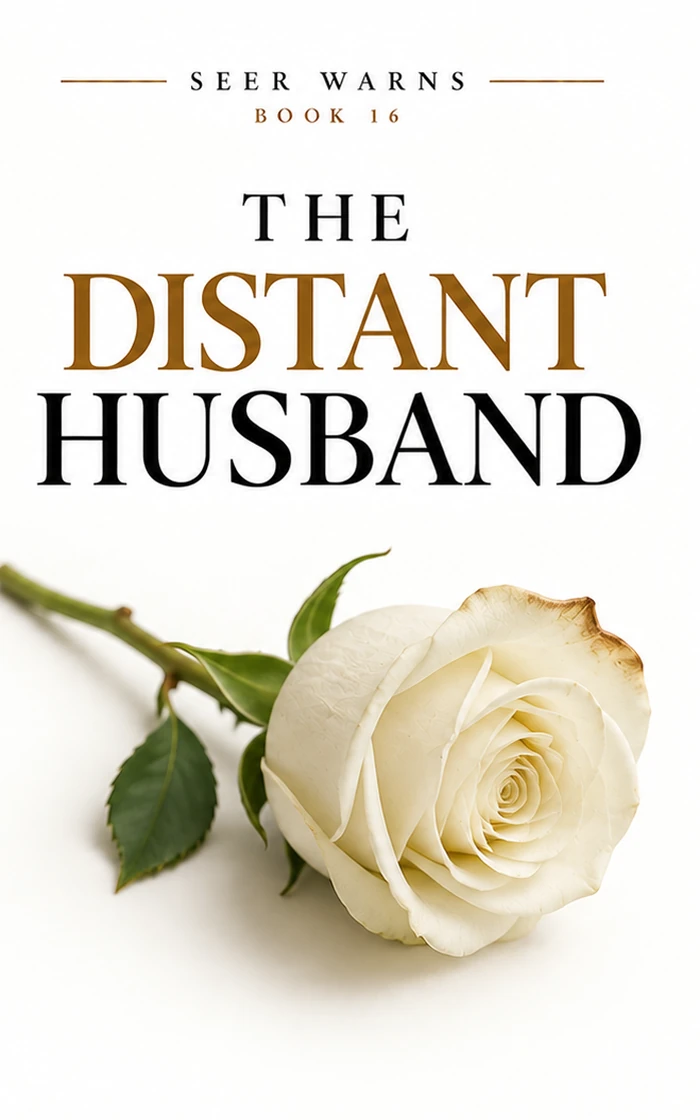
Then the one impossible specific: the Sunday-morning Moleskine, the pen on the heavy paper, the composition Nina is the subject of and does not know, the part of James no person has ever been inside. The woman selects a single white rose from his paid bouquet, one with a faint brown arc at the lip of a petal, the flaw a client would ask to be replaced, and sets it on the counter beside the box. When James looks up she is gone, the bell never rang, the florist Margaret never saw her. Margaret would not have sold a bruised rose; James would have asked to replace it; he did not. The rose is his. That night he presses it into the back of the notebook and tells Nina about neither.
The warned choice.
Loss A: marry Nina and let the wall do what the wall does. Build the distance one chosen studio hour at a time, answer the question that changes tense (where were you to where are you) with a revised, decorative sentence, cancel the session that would have been the room with two chairs, and lose the wife, and teach the daughter the composure that is the wound.
Loss B: be in the room. Put down the pen that is the intermediary, stop choosing the hours that are not required, let Nina all the way in past the wall, do the thing the toast swears he wants and does not know if he can do.
James believes the woman because the Moleskine is the gauge and no one alive could know it. And he marries Nina anyway and builds the wall anyway, because being in the room is a thing he would have to do, and the wall is the thing he is. The cruelty is that the toast is true and the wall is true in the same man at the same table: he means every word, and he has already seen how it ends.
The fracture tell.
The notebook, and the bruised rose. The Sunday drawing is the measure of the distance, the pen standing in for the nearness James cannot give; the book tracks the marriage in the frequency of his initiating, tapering to nothing the body registers before the mouth does. The bruised rose, pressed alone in the back of the notebook under a catalog of other people’s chairs, is the warning that survives; when Nina finds it and turns it over and leaves it for him to see, the reader knows she has read the whole composition.
The outcome.
Complete collapse. Everything the woman named arrives: the work that becomes the room, the revised sentences, Lily’s question in a doorway with a red leash, the cancelled session that is the exit James cannot call an exit, and the note on the counter in the architect’s precise hand, saying what Nina is trying to say, that he believed himself and she believed him and neither was lying, and what he is is just stronger than what he wants to be. The book ends on a Sunday morning in the Grand Street apartment: the empty made side of the bed, the dog on the floor, the Chemex washed clean, the notebook moved to Nina’s nightstand, and a blank page James holds the pen over and does not yet draw. The blank page is not the designed negative space he has composed for thirty-eight years; it is just blank, undesigned, the page before the first stroke. Dr. Kemp’s sentence: That’s where we start.
How it touches the other books.
One of the series’ books set outside Harmon, in the larger valley city of Caldwell, where the design studios occupy the second floors and the rain is a condition rather than a problem. It rhymes thematically with The Design Partner’s drafting tables and with the wall-building men across the series, the distance a careful man builds and calls work, the same shape as The Good Father’s and The Quiet Man’s in a different trade.